


Walt Disney World vs. Disney Cruise: Which Actually Delivers the Better Family Vacation in 2026?

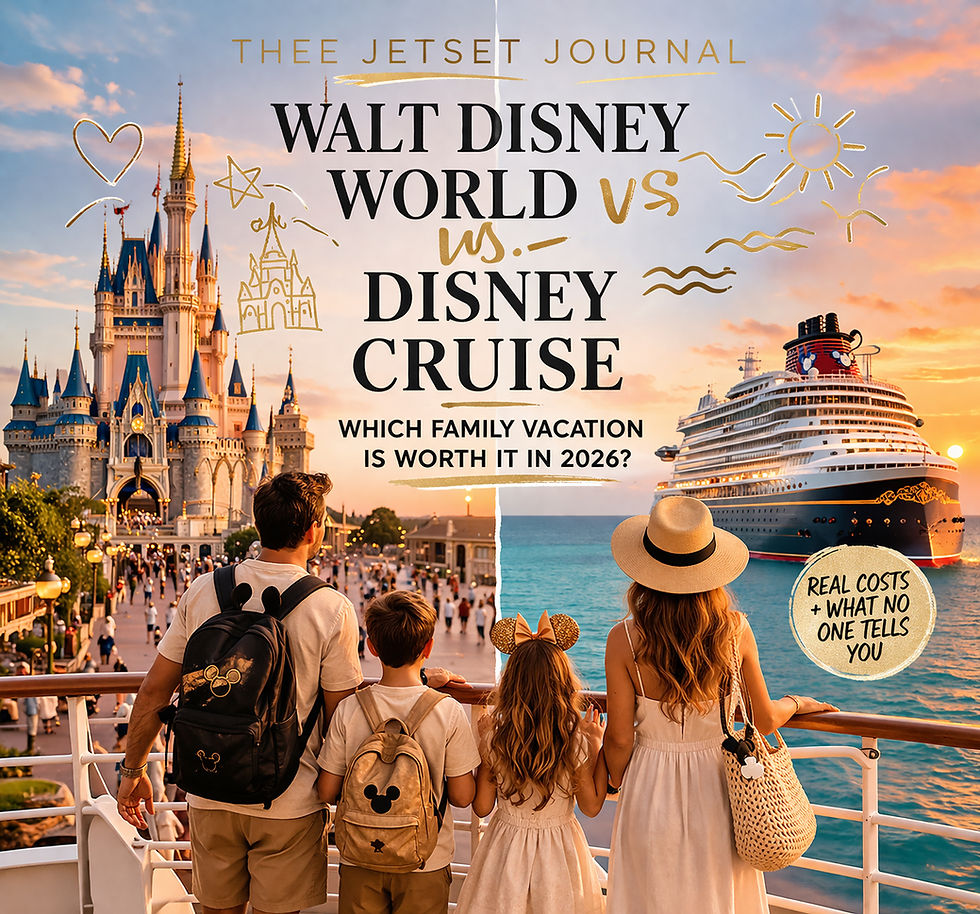
For a long time, this wasn’t much of a debate.
If you wanted the “big” Disney trip, you went to Walt Disney World. If you wanted something different, maybe a little more relaxed, you looked at Disney Cruise Line.
But that gap has narrowed—fast.
Prices have climbed on both sides. Perks have shifted. And what used to feel like two very different tiers of vacation now lands in a surprisingly similar price range for a family of four. Which means the real question isn’t “which is cheaper?” anymore. It’s: what kind of trip are you actually trying to have?
The Price Story Isn’t What It Used to Be
On paper, Walt Disney World still looks like the more approachable option.
You can piece together a five-day trip with a moderate hotel, park tickets, and the basics for somewhere in the $6,000 range. Stay on property, add four or five park days, feed everyone, sprinkle in Lightning Lane access so you’re not standing in two-hour lines all afternoon—and suddenly that number creeps closer to $8,000 or even $9,000 without doing anything particularly extravagant.
And that’s the thing people don’t always realize until they’re in it: Disney World pricing is layered. You’re constantly making small spending decisions that feel optional in the moment but add up quickly. Skip this, add that, upgrade here—it’s flexible, but it’s also quietly relentless.
A Disney Cruise flips that dynamic.
Yes, the upfront price can feel like a punch. A four- or five-night sailing in 2026 will likely run a family of four somewhere between $6,000 and $10,000 depending on cabin type and timing. That number tends to scare people off at first glance.
But once you’re on board, the meter more or less stops running.
Meals are included. Shows are included. Kids clubs—arguably some of the best in the industry—are included. You’ll still pay for things like excursions, specialty dining, and gratuities, but the day-to-day spending pressure is dramatically lower. The difference is psychological as much as financial: you’re not constantly reaching for your wallet.
In practice, both vacations often land in the same overall range. One just feels more predictable when you get there.
Two Completely Different Speeds of Vacation
This is where the decision really starts to take shape.
Walt Disney World is exhilarating—but it’s not relaxing. Not really.
You’re waking up early to book rides, navigating crowds before the heat kicks in, crisscrossing parks, checking wait times, adjusting plans on the fly. There’s a rhythm to it, and if you know how to work the system, it can be incredibly rewarding. You’ll pack a lot into a single day.
But you’ll feel it.
By day three, most families are running on a mix of adrenaline and caffeine. Kids get tired. Parents get strategic. And the whole thing starts to feel a little like a well-managed operation.
A Disney Cruise, by contrast, feels almost disorienting at first—because of how little you have to manage.
You wake up when you want. Breakfast is waiting. The kids disappear into the Oceaneer Club, and suddenly you’re sitting by a pool with no agenda. There are shows, activities, and character moments throughout the day, but none of it requires the same level of planning or competition.
You’re not trying to “win” your vacation.
And for a lot of families, especially those who’ve done Disney World before, that shift is everything.
Who Each Vacation Really Works For
If your kids are laser-focused on rides—if they’ve been watching videos, making lists, talking about specific attractions for months—Walt Disney World is still the clear choice. There’s no substitute for that scale or that level of immersion. It’s a rite of passage for a reason.
It also makes sense for first-timers. There’s something about seeing the castle in person, walking down Main Street, doing the parks in sequence—it delivers on a very specific kind of expectation.
But the calculus changes if you’ve already been, or if your kids are younger.
A Disney Cruise tends to hit a sweet spot for families with kids roughly in the 3–10 range. Old enough to take full advantage of the kids clubs, young enough that they’re not chasing thrill rides all day. And for parents, it’s one of the rare vacations where you actually get a break without paying extra for childcare.
That’s not a small thing.
It also appeals to a different kind of traveler—the one who doesn’t want to spend weeks planning dining reservations or refreshing an app at 7 a.m. just to secure a ride time.
The Trade-Offs You Don’t See in the Brochures
Neither option is perfect, and the trade-offs are real.
At Walt Disney World, the biggest friction point right now is how much of the experience feels tied to paid upgrades. Lightning Lane has become less of a bonus and more of a necessity if you want to avoid long waits. Food prices have climbed steadily. Even getting around the property can eat into your day more than you expect.
It’s not just expensive—it can feel a little transactional.
On the cruise side, the limitations are different. Cabins, unless you upgrade, are tighter than a typical hotel room. Port excursions can get pricey fast, especially if you’re booking for four people. And if your idea of a Disney vacation revolves around big-ticket rides, you won’t find that same lineup at sea.
You’re trading variety for ease. Whether that’s a good deal depends entirely on your priorities.
Where the Value Equation Is Heading
There’s also a bigger shift happening behind the scenes.
Disney has been steadily repositioning Walt Disney World toward a more à la carte model. Lower the perceived entry price, then monetize the experience through add-ons. It’s a strategy that mirrors airlines and hotels—and it works, but it changes how the vacation feels.
Disney Cruise Line has gone the other direction.
Prices have gone up, no question, but the company has leaned into a premium, bundled experience. Fewer decisions, fewer surprise costs, more emphasis on service and consistency.
The result is interesting: even when the cruise costs the same—or slightly more—it often feels like the better value.
Not because it’s cheaper, but because it’s clearer.
So, Which One Should You Book?
If this is your first big Disney trip, or if your family is all about rides and iconic moments, Walt Disney World still earns its place. It’s bigger, louder, and packed with the kind of experiences you can’t replicate anywhere else.
But if you’re looking for something that actually feels like a vacation—something where the kids are entertained, the logistics are handled, and you’re not constantly doing mental math on what things cost—the Disney Cruise is the stronger play right now.
Especially in 2026, when theme park costs continue to climb and planning has become part of the workload.
The short version:
Go to Walt Disney World if you want the full, high-energy Disney experience and don’t mind working for it.
Book the Disney Cruise if you want a smoother, more contained trip that still delivers the magic—without the friction.
For more families than ever, the cruise isn’t just an alternative.
It’s the upgrade.


Comments