


Spirit Airlines Has Ceased Operations — What Stranded Travelers Need to Know Right Now

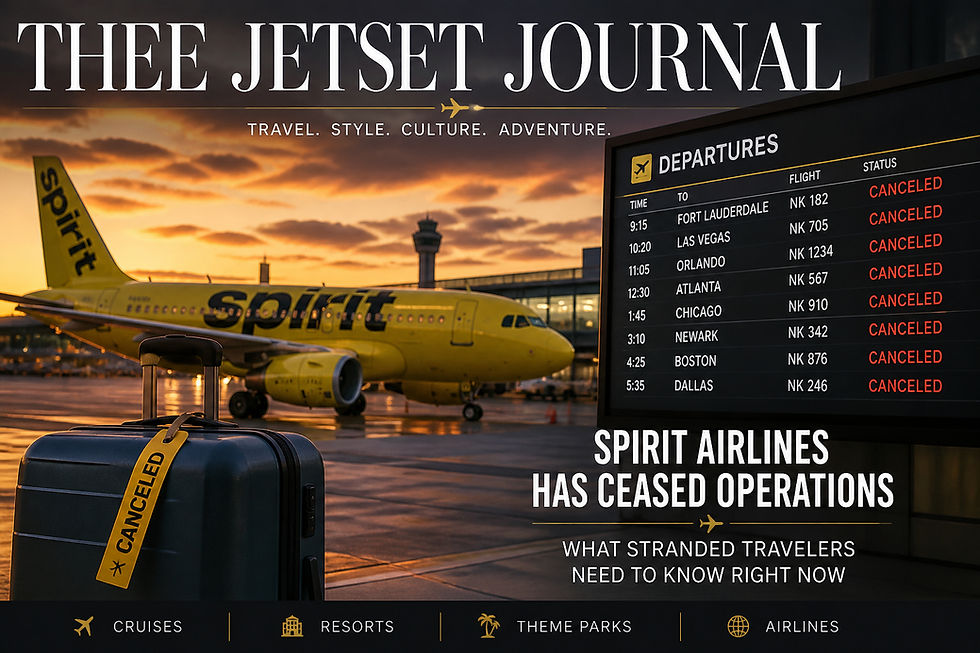
The unthinkable has happened for millions of budget-conscious flyers: Spirit Airlines has shut down, grounding its fleet and bringing one of the most polarizing business models in modern aviation to a sudden stop.
This isn’t just another airline headline you scroll past. It’s immediate. It’s personal. Travelers are showing up at airports with confirmed bookings that no longer exist, staring at departure boards that have quietly erased their plans. And unlike a delay or even a cancellation, there’s no recovery flight coming later in the day.
What makes this moment land harder is how embedded Spirit had become in everyday travel. For a lot of people, it wasn’t just the cheapest option—it was the only one that made certain trips possible. Its absence leaves a gap that isn’t easily filled.
What Happened — In Practical Terms
Spirit Airlines has stopped flying. Completely.
That means every scheduled flight is canceled, and there’s no internal rebooking process to fall back on. If you had a reservation, it’s effectively unusable. Customer service channels may exist in some form, but they’re likely overwhelmed—or in some cases, going dark altogether.
This isn’t a disruption you can wait out. It’s a reset. You’ll need to make new plans from scratch.
And that distinction matters. In a typical airline hiccup, there’s at least a path forward within the same system. Here, that system is gone.
Context: We’ve Seen Airline Failures Before—But This One Hits Differently
The U.S. airline industry isn’t immune to collapse. Names like Pan Am and ATA Airlines are reminders of that.
But Spirit’s shutdown feels more disruptive because of timing and positioning.
Ultra-low-cost carriers didn’t just compete on price—they reshaped the pricing psychology of air travel. Even if you never flew Spirit, chances are you benefited from it. Legacy airlines like American Airlines and Delta Air Lines were pushed to respond, introducing stripped-down fares and more aggressive pricing just to keep up.
Spirit also owned a specific kind of route: high-demand, leisure-heavy, price-sensitive. Think Florida runs, Vegas weekends, quick Caribbean escapes. When an airline like that disappears, it’s not just capacity that vanishes—it’s a whole pricing layer.
The closest parallel might be WOW Air collapsing almost overnight. But that was largely transatlantic. This is happening right in the core of domestic U.S. travel.
Why This Is Really Happening
The official language will point to financial strain. That’s accurate—but incomplete.
Spirit’s entire model was built on a delicate balance: ultra-low base fares paired with a steady stream of add-on revenue. Bags, seat assignments, even printing a boarding pass—those extras weren’t side income, they were essential.
That model only works when planes are full and costs are predictable. Neither has been a given lately.
Fuel and labor costs have crept up, sometimes sharply. At the same time, traveler expectations have shifted in ways that aren’t always obvious on the surface. There’s a growing willingness to pay a bit more for a smoother experience—or at least one that feels more reliable.
And then there’s competition. Not just from fellow low-cost carriers like Frontier Airlines, but from the legacy airlines that quietly adapted. When a full-service airline can get close to your price—and still offer a broader network and better recovery options—the math starts to break.
One industry reality that doesn’t get talked about enough: the middle is where airlines get squeezed. Spirit wasn’t competing in a vacuum. It was being boxed in from both ends—by rising costs on one side and evolving competitors on the other.
What This Means for Travelers
If you had a Spirit flight booked, the immediate impact is straightforward, even if the situation isn’t.
You’ll need a new flight. And you’ll likely pay more for it.
Routes that Spirit dominated—Orlando, Fort Lauderdale, Las Vegas—are already feeling tighter. When capacity drops suddenly, prices don’t stay still for long.
There’s also the question of refunds. In a best-case scenario, you’ll get your money back through your original form of payment. In a more complicated one, you may find yourself navigating claims, delays, or even formal proceedings depending on how things unfold behind the scenes.
Here’s the part that’s easy to overlook: many Spirit passengers booked those flights because they didn’t have much pricing flexibility to begin with.
Rebooking at current fares isn’t just inconvenient—it can be out of reach.
That’s where the real disruption sits.
What Travelers Should Do Next
This is one of those moments where hesitation works against you.
Start by rebooking as soon as possible—but don’t lock into the first option you see. Prices are moving, and availability is uneven. Check multiple airlines and be open to less obvious routes.
Nearby airports can make a meaningful difference. A flight out of Tampa instead of Orlando, or into a secondary airport instead of the main hub, might save you hundreds.
It’s also worth digging into your credit card benefits. Some offer built-in protections for exactly this kind of situation—airline insolvency included. It’s not guaranteed, but when it applies, it can be far more efficient than waiting for an airline-led refund.
Alternative carriers will start to absorb some of the displaced demand. Allegiant Air and Frontier Airlines are the most obvious substitutes, though they come with similar trade-offs. Southwest Airlines, meanwhile, often becomes more competitive in moments like this—especially if you’re willing to piece together a trip using one-way fares.
And yes, piecing things together may be the move. A connection here, a one-way there, maybe even a short drive to bridge the gap. It’s not elegant, but it can work.
Whatever you do, keep records. Confirmations, receipts, cancellation notices—save all of it. If reimbursement becomes an option later, documentation will matter.
The Bigger Trend Behind This Shift
There’s a temptation to see this as a one-off event. It’s not.
The ultra-low-cost model has been under pressure for a while. Spirit’s shutdown just brings that tension into focus.
Those rock-bottom base fares—the ones that made headlines—were always part of a larger equation. As costs rise and expectations shift, that equation gets harder to balance.
What we’re likely moving toward is a more blended landscape. Budget options won’t disappear, but they may look different: fewer extremes, more bundled pricing, and less of the “everything is extra” approach.
At the same time, the industry continues to consolidate, whether through mergers, partnerships, or, in this case, attrition. Fewer players usually mean a more stable system—but also one where pricing power is more concentrated.
And then there’s the traveler mindset. Reliability is having a moment. After years of disruptions, cancellations, and uncertainty, people are placing a premium—sometimes literally—on getting where they’re going without drama.
That shift matters.
A Quick Look at What Comes Next
No single airline steps neatly into Spirit’s place.
Frontier Airlines comes closest in structure, but it’s not a one-to-one replacement. Allegiant Air has a strong niche but limited flexibility. Southwest Airlines sits somewhere in between, often feeling like a safer—if slightly pricier—bet.
Legacy carriers will pick up some of the slack, but not necessarily at the same price point travelers were used to.
The reality is, replacing Spirit isn’t just about adding flights. It’s about replacing a very specific kind of access to travel.
The Bottom Line
Spirit Airlines’ shutdown isn’t just a disruption—it’s a turning point.
If you’re affected, the path forward is clear, even if it’s not ideal: rebook quickly, stay flexible, and use every tool available to offset the cost. Waiting won’t improve your options.
Stepping back, this moment says something bigger about where air travel is headed. The era of ultra-cheap, no-frills flying at scale is under strain, and the industry is adjusting in real time.
For travelers, that likely means fewer rock-bottom deals—but, perhaps, a more stable experience overall.
Whether that trade-off feels worth it will depend on who you ask.


Comments